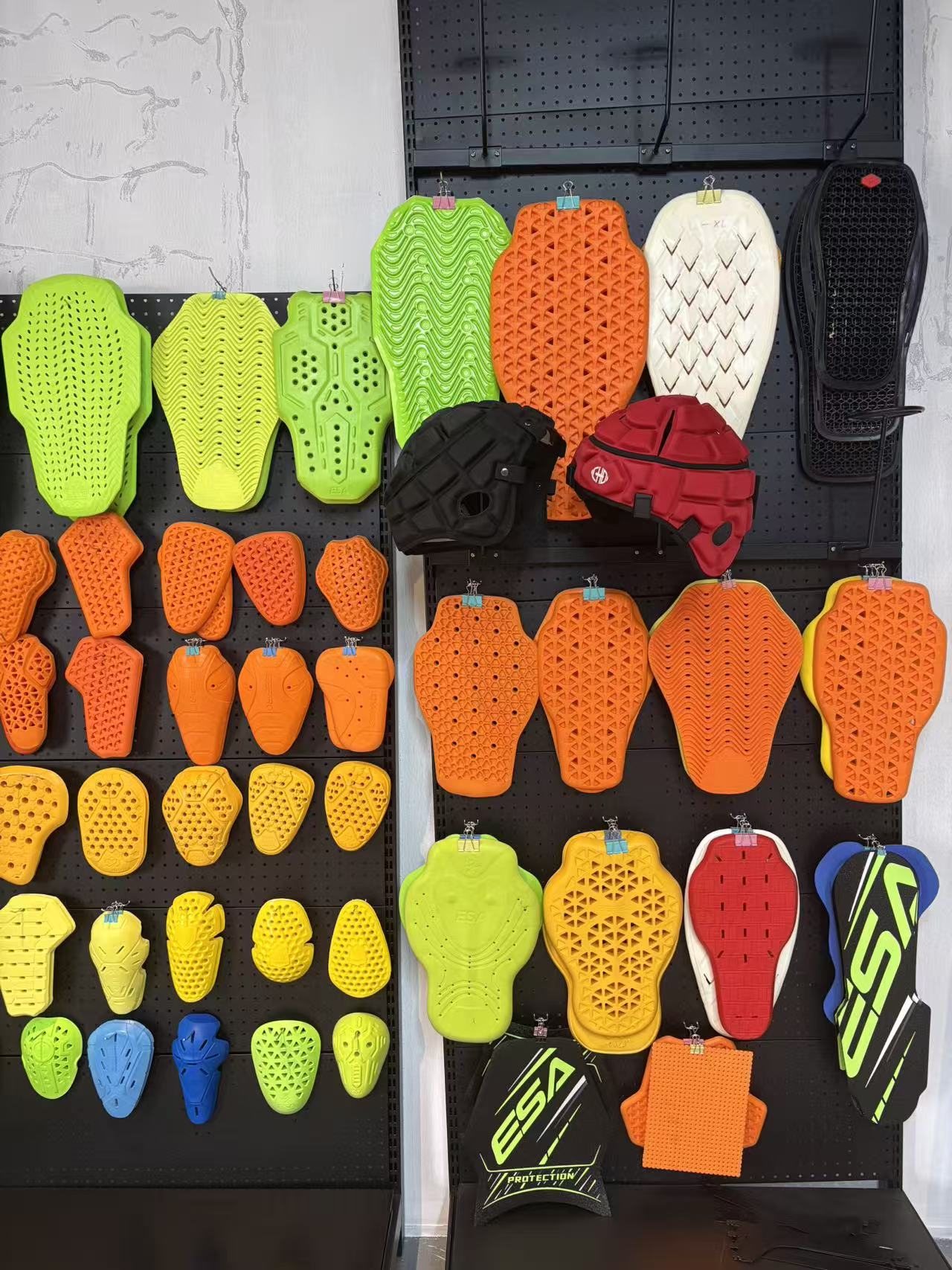
Three materials dominate modern ski and snowboard protection: XRD, D3O, and EVA foam. Each uses a different mechanism to absorb impact, and each performs differently in cold weather, multi-impact conditions, and at different price points. The right choice depends on riding style, climate, and certification requirements. XRD is a polyurethane-based material that remains flexible down to -40°C and absorbs up to 90% of impact energy on a single hit. D3O is a non-Newtonian shear-thickening foam that stays soft and pliable until impact, then instantly locks rigid on contact. EVA foam is the industry-standard closed-cell foam used across entry-level and mid-range protectors, with cold-tolerant variants extending its usability into alpine conditions. PEONYHK uses all three materials across its product line, allowing buyers to match protection technology to price point and use case.
XRD: Premium Cold-Weather Performance
XRD is manufactured by Rogers Corporation and consists of specially engineered polyurethane molecules that flow freely during slow movement but lock together on sudden impact. The material maintains flexibility across an enormous temperature range — from -40°C to +80°C — making it the preferred choice for arctic skiing, expedition use, and ski patrol professionals. XRD also delivers the highest single-impact absorption rate of the three materials, dissipating up to 90% of crash energy. The trade-off is price: XRD protectors typically cost 30–60% more than D3O equivalents and weigh slightly more. PEONYHK incorporates XRD into its top-tier back protectors (BP-005 series) for mountain guides and competitive ski racers who cannot afford to compromise on cold-weather performance.
D3O: Versatile All-Around Performance
D3O is a non-Newtonian foam that behaves like a viscous liquid at rest and instantly stiffens on impact. Sliders and inserts made from D3O are soft, flexible, and barely noticeable during normal movement, but harden into a protective shell the instant force is applied. D3O's softness makes it ideal for back protectors that need to disappear under a ski jacket during all-day wear. It performs well down to about -20°C — adequate for most European and North American resorts — but drops off in extreme polar conditions. PEONYHK specifies D3O inserts in its mid-range back protectors (BP-001 / BP-002 / BP-003 series), giving buyers a high-protection, low-profile option at a mid-tier price.
EVA Foam: The Industry Standard
Ethylene-vinyl acetate (EVA) foam has been the workhorse material of ski protection for decades. It is closed-cell, water-resistant, low-cost, and provides reasonable impact absorption up to about -10°C. Standard EVA hardens and loses elasticity below that point, which is why racing and backcountry ski protection has moved toward smart foams like D3O and XRD. However, special EVA formulations — including low-temperature EVA blended with nitrile rubber or thermoplastic elastomers — can extend usable performance down to -30°C. PEONYHK uses these cold-tolerant EVA blends in its entry-level protectors and kid-specific lines, where cost and flexibility matter more than absolute impact performance. EVA remains the right choice for kids' products where comfort, lightweight construction, and price outweigh maximum crash protection.
Comparison: XRD vs D3O vs EVA
Cold tolerance: XRD (-40°C) > cold-tolerant EVA (-30°C) > D3O (-20°C) > standard EVA (-10°C). Single-impact absorption: XRD (90%) > D3O (80%) > cold-tolerant EVA (65%) > standard EVA (50%). Multi-impact recovery: D3O and XRD both recover from multiple hits; standard EVA degrades quickly after 2–3 impacts. Weight: All three are similar at low thicknesses; XRD becomes heavier at full coverage. Price: standard EVA is cheapest, cold-tolerant EVA roughly 1.5×, D3O roughly 2×, and XRD roughly 3× of baseline EVA. Best use: XRD for backcountry / racing, D3O for resort all-mountain, cold-tolerant EVA for entry-level and kids, standard EVA for low-cost casual gear.
How to Choose the Right Material
Match the material to your typical riding conditions. If you ride sub-zero days (most of the season at high-altitude resorts like Aspen, Whistler, or Chamonix), prioritize XRD or cold-tolerant EVA. If you ride varied conditions across Europe and North America, D3O delivers excellent all-around performance. For casual skiers, kids, or cost-sensitive buyers, EVA remains a sensible choice. PEONYHK back protectors cover the full material range — BP-005 with XRD for high-end buyers, BP-001 with D3O for mid-range, and P-series with EVA for entry-level. All meet EN 1621-1 certification requirements, ensuring certified protection regardless of the underlying material.
Frequently Asked Questions
Which material is best for kids' ski protection?
EVA and cold-tolerant EVA blends work well for kids because the material is flexible, lightweight, low-cost, and offers adequate protection for typical low-speed falls. PEONYHK's kid line uses a cold-tolerant EVA with reinforced edge stitching that balances comfort, weight, and protection.
Does D3O lose its protective properties in extreme cold?
D3O's molecular shear-thickening mechanism works down to approximately -20°C; below that, the activation slows and protection is reduced. For arctic or high-altitude skiing consistently below -20°C, XRD is the safer choice.
Can XRD and D3O be combined in the same protector?
Yes — many high-end protectors use XRD in the high-impact center spine area and D3O around the edges for better fit and ventilation. PEONYHK's BP-005 series uses this hybrid construction to balance maximum protection with all-day wearability.
How does impact material affect CE certification?
EN 1621-1 certification tests the finished protector, not the material itself. Both XRD and D3O can be certified to Level 1 or Level 2; the difference is in the design, not just the material. Always verify the certification in the test report rather than assuming a material is automatically compliant.
Need a custom OEM back protector using a specific material? PEONYHK manufactures ski protection in EVA, cold-tolerant EVA, D3O, and XRD — sample lead time is 5–7 days, full production in 15–25 days for most orders.