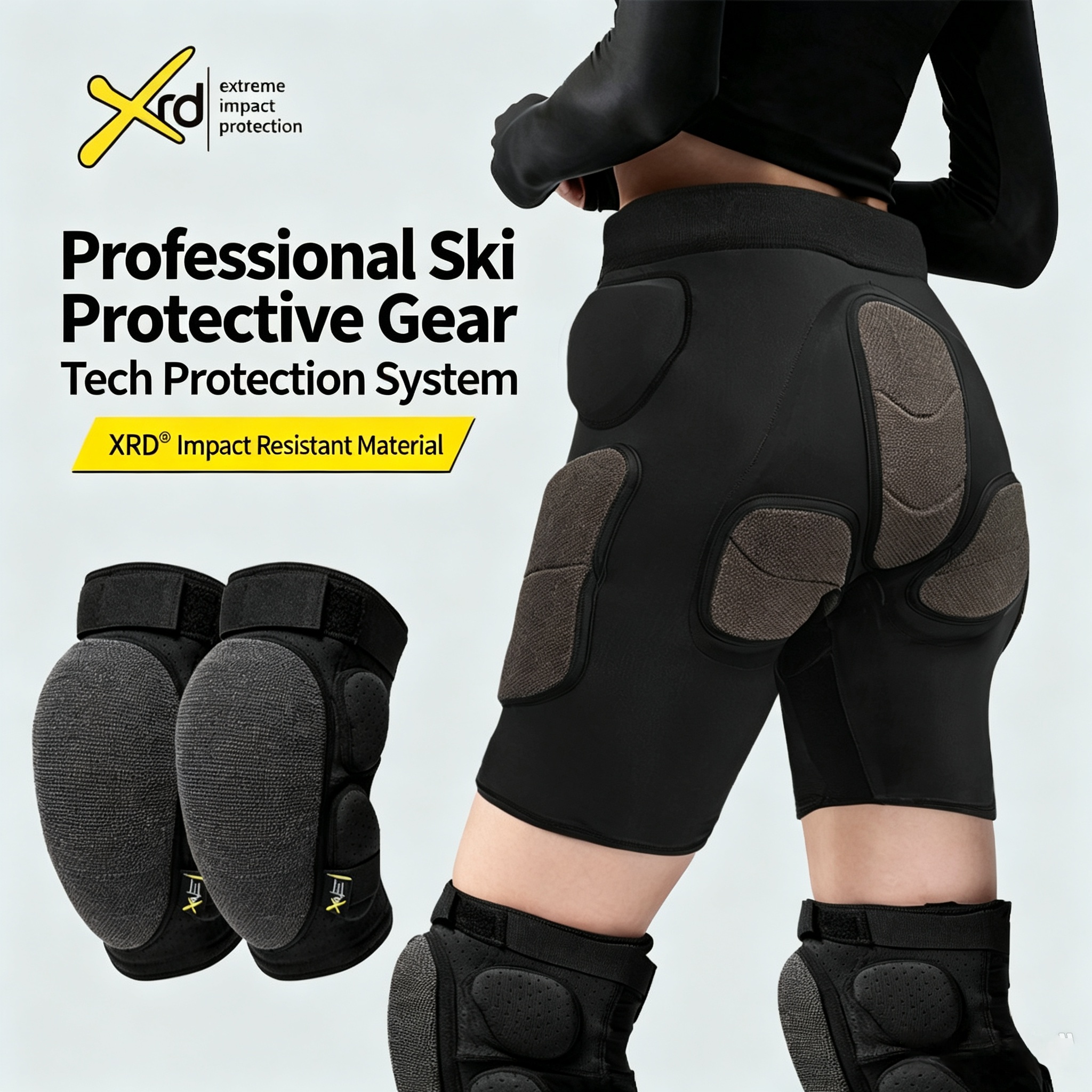
Why the foam material inside impact shorts matters more than brand or price
Ski impact shorts protect the hip, tailbone, and butt from crash forces during ski and snowboard falls. The protective foam inside the shorts is what actually absorbs the impact — not the outer fabric, not the brand label, not the price. Three foam families dominate the market: EVA foam (the budget standard), D3O (the mid-tier intelligent material), and XRD (the premium cold-weather option). Each uses a different physical mechanism, performs differently in cold conditions, and costs differently. This guide compares all three so B2B buyers can match material to their brand positioning, target market, and price point.
EVA foam: the industry workhorse
EVA (ethylene-vinyl acetate) is the most widely used impact foam in ski protection. It is closed-cell, water-resistant, lightweight, and low-cost. PEONYHK's standard EVA delivers roughly 50–60% impact absorption at room temperature and remains effective down to about -10°C. Cold-tolerant EVA formulations blended with nitrile rubber extend usable performance to -30°C at modest cost premium. The trade-off: EVA permanently deforms after 2–3 hard impacts, so the protection rating drops over a season of heavy use. For entry-level ski protection brands and kids' lines, EVA is the right choice. PEONYHK's AP-IS-60 and P-1 use cold-tolerant EVA blends tested at -20°C.
D3O: intelligent material that stays soft until impact
D3O is a non-Newtonian shear-thickening foam that behaves like a viscous liquid during normal movement but instantly locks rigid when struck. The benefit: D3O pads feel soft and flexible against the body, making them ideal for back protectors and impact shorts that need to disappear under clothing. D3O absorbs roughly 80% of impact energy on a single hit and recovers from multiple impacts without permanent deformation. It performs well down to about -20°C, adequate for most European and North American resorts. For mid-tier ski protection brands targeting resort and all-mountain skiers, D3O is the best balance of protection, comfort, and price. PEONYHK uses D3O inserts in its mid-range back protectors and ski knee pads.
XRD: premium cold-weather performance
XRD is a polyurethane-based material made by Rogers Corporation that maintains flexibility from -40°C to +80°C. XRD absorbs up to 90% of crash energy on a single hit and is the preferred choice for arctic skiing, ski patrol professionals, ski mountaineering, and competitive ski racing. The trade-off is price: XRD protection costs 30–60% more than D3O equivalents and adds modest weight at full coverage. For premium ski protection brands selling to backcountry skiers, mountain guides, and racers, XRD is the only choice that holds up in extreme cold. PEONYHK's AP-IS-57 uses XRD specifically for cold-resistant impact shorts.
Material comparison table
| Material | Cold Tolerance | Single-Impact Absorption | Multi-Impact | Relative Cost | Best For |
|---|---|---|---|---|---|
| Standard EVA | -10°C | 50–60% | Degrades after 2–3 hits | $ | Entry-level, kids, warm conditions |
| Cold-tolerant EVA | -30°C | 55–65% | Better than standard EVA | $$ | Mid-tier, all-mountain, alpine resorts |
| D3O | -20°C | 80% | Recovers from multiple hits | $$$ | Mid-to-high tier, resort racing, all-mountain |
| XRD | -40°C | 90% | Recovers from multiple hits | $$$$ | Premium, backcountry, ski patrol, racing |
How to choose the right material for your brand
For ski protection brands sourcing OEM from a Chinese factory, the choice between EVA, D3O, and XRD depends on three factors: your target market's climate, your retail price point, and the certification requirements of your destination market. If you sell primarily to European resort skiers (warmer conditions), cold-tolerant EVA gives 90% of the protection at 50% of the price. If you sell to North American backcountry skiers and ski mountaineers, D3O or XRD is essential. If your market is alpine racing, ski patrol, or Arctic expeditions, XRD is non-negotiable. PEONYHK's OEM service can mix materials within the same product line — for example, EVA at the hip and XRD at the tailbone — to balance cost and protection.
Frequently Asked Questions
Can I use multiple foam types in the same product?
Yes. Hybrid constructions are common: D3O inserts at high-impact zones (tailbone, hip bone) combined with cold-tolerant EVA at lower-impact areas (thigh, side). PEONYHK frequently designs hybrid impact shorts to balance protection, weight, and cost for OEM customers.
What's the difference between D3O and D3O similar?
D3O is a brand name and trademarked material made exclusively by D3O Lab. D3O similar refers to non-D3O materials that mimic the shear-thickening behavior — typically Chinese-manufactured equivalents sold at lower cost. Performance is similar but certification documentation may differ.
Which foam is best for kids' ski impact shorts?
Cold-tolerant EVA. Kids are lighter, fall slower, and need comfort and flexibility more than maximum impact protection. PEONYHK's kids impact shorts use EVA blended for cold tolerance and softness.
How do I verify a factory's foam claims?
Request the foam supplier's technical data sheet (TDS), third-party test reports (TUV, SGS, Intertek), and a sample for in-house testing. PEONYHK provides TDS, test reports, and free samples for all impact shorts and back protectors.
Need help matching materials to your ski protection line? PEONYHK provides free material consultation, 5-7 day sample lead time, and 100 pcs MOQ for OEM ski impact shorts. Contact vivi@hkpeony.com for technical specs and pricing.