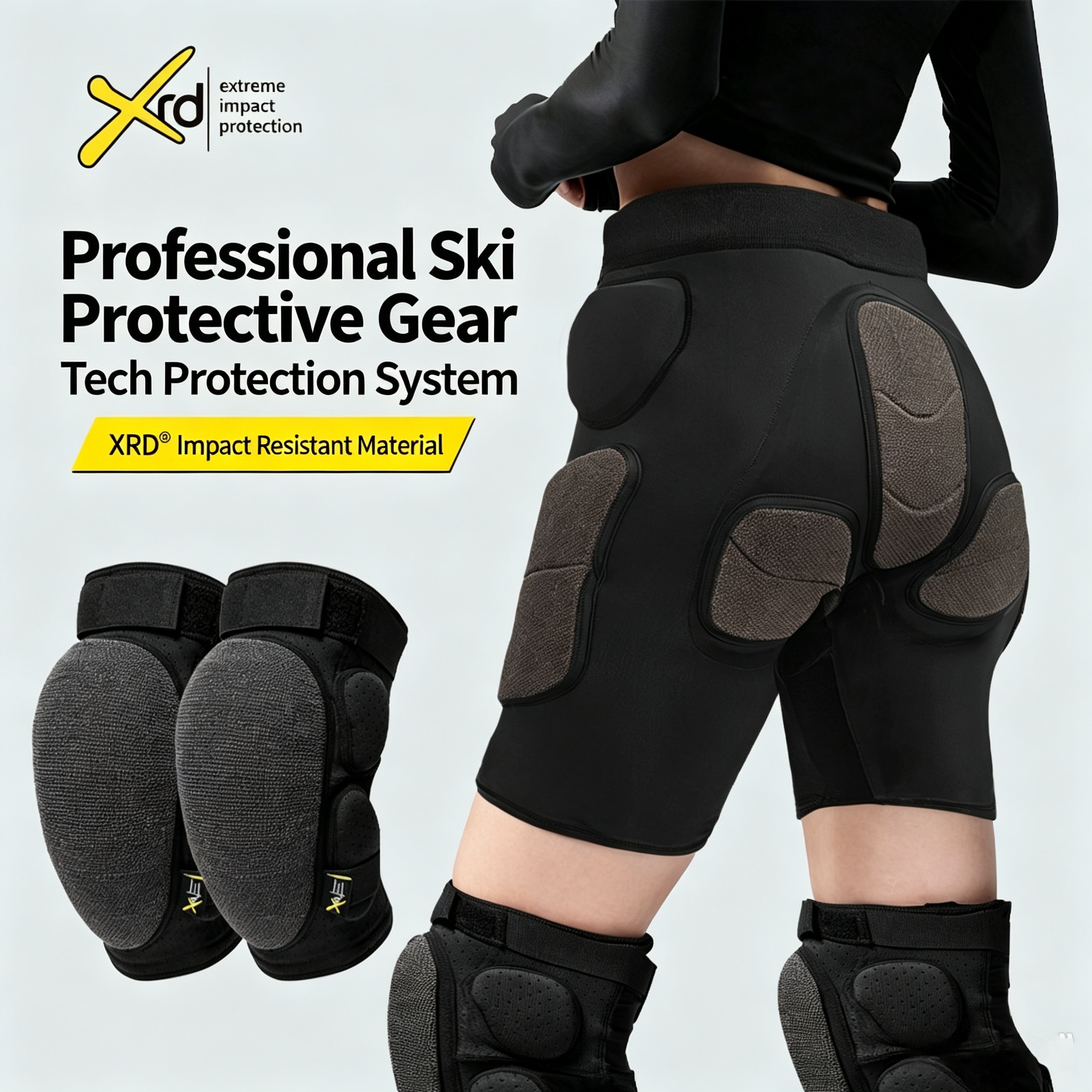
Why fabric composition matters for ski compression shorts
A ski compression short is not a single material — it is a layered system of three chemically distinct synthetic fibers working together. The outer shell fabric (the part touching your skin) must stretch with the body, recover its shape after every fall, wick sweat away from the skin, stay soft at -20°C, and survive 30+ machine washes per season. Globally, three fibers do almost all of this work: polyester (the durable base), spandex (the stretch engine), and nylon (the premium soft alternative). This guide explains each fiber with real test data, then shows how they combine into the two blends Peony HK Limited actually uses — 88% polyester / 12% spandex (stock value tier) and 82% nylon / 18% spandex (custom premium tier).
1. Polyester (PET) — the durable base fiber
Polyester is a fully synthetic polymer (polyethylene terephthalate, PET) first commercialized by DuPont in 1951 and now the world's most-produced fiber (around 60 million tonnes per year, source: Textile Exchange Materials Market Report 2023). For compression shorts, polyester is almost always knitted (not woven) into a 4-way stretch fabric. It serves as the durable, low-cost base of the fabric. Key measurable properties:
- Moisture regain: 0.4% (very low — hydrophobic). Means polyester does not absorb sweat into the fiber; it wicks it across the surface to evaporate. Dries faster than cotton or nylon.
- Tensile strength: 3.5–7.0 g/denier (dry), depending on yarn count.
- UV resistance: Excellent. Polyester is the most UV-stable common synthetic; it retains strength and color far longer than nylon in direct alpine sun.
- Abrasion resistance: Good, but not the best (lower than nylon).
- Hand feel: Slightly coarser than nylon at the same yarn count. Modern microfiber polyester closes the gap.
- Cost: Lowest of the three. Approximately $3–6/kg finished knit fabric in 2024.
Polyester is the default in value-tier compression shorts. Peony HK Limited's stock blend is exactly this construction: 88% polyester + 12% spandex, 200–220 GSM, optimized for fast drying, UV durability, and accessible pricing.
2. Spandex / Elastane / Lycra — the stretch engine
Spandex (US generic name) / Elastane (EU/Asia generic name) / Lycra (Invista brand, USA) / Dorlastan and Roica (Asahi Kasei, Japan) / Creora (Hyosung, Korea) is the same fiber: segmented polyurethane (PU). It can stretch 500–700% of its original length and recover >95% of that stretch. Unlike polyester and nylon — which can each be used alone in some fabric constructions — spandex is never used alone. It is always 2–30% of the fabric, blended with the base fiber. Without spandex, no compression short would compress; without a base fiber, spandex would snap.
Key measurable properties:
- Elongation at break: 500–700%.
- Recovery: >95% after 5× stretching (Invista Lycra technical bulletin).
- Wash durability: Loses ~50% recovery after 50–100 wash cycles under normal conditions; chlorine bleach and high-heat tumble drying cut this in half.
- Heat sensitivity: Yellows above 150°C; melts around 230°C. Sets the ironing ceiling.
- Cost: $8–15/kg; branded Lycra (Invista) carries a 20–30% premium for tighter lot consistency.
The amount of spandex in a fabric controls its compression force. Below 10% spandex, the fabric is stretchy but does not compress — pads shift during riding. Above 30%, the fabric loses tensile strength and feels rubbery against the skin. The sweet spot for ski compression shorts is 12–22% spandex, which is why our standard blends sit at 12% (stock poly-spandex) and 18% (custom nylon-spandex).
3. Nylon (Polyamide, 锦纶) — the premium soft alternative
Nylon is also fully synthetic (a polyamide, PA; called 锦纶 in Chinese technical textile standards), first commercialized by DuPont in 1939 as a replacement for silk. The two common types are Nylon 6 and Nylon 6,6 — both used in compression wear, with Nylon 6 slightly softer and Nylon 6,6 slightly stronger and more heat-resistant. Nylon can be used as a direct substitute for polyester in compression shorts, where it produces a softer, more abrasion-resistant garment at higher cost. Key measurable properties:
- Moisture regain: ~4% (about 10× polyester). Nylon absorbs more moisture into the fiber itself, giving a cooler, damper feel against the skin in heavy exertion. Dries slower than polyester.
- Tensile strength: 5.0–9.5 g/denier for Nylon 6 — the highest of the three common synthetics. Nylon 6,6 is higher still.
- UV resistance: Poorest of the three. Nylon degrades measurably under prolonged UV exposure; alpine guides and patrollers who log 100+ days a season often notice shoulder fading on jackets and outer shorts.
- Abrasion resistance: Best of the three. Nylon is the reference standard for abrasion-heavy applications (military, mountaineering, motorcycle).
- Hand feel: Softest of the three, especially in microfiber form. Why premium compression shorts use nylon: the on-skin feel is closer to silk than to typical poly.
- Cost: Highest of the three. Approximately $6–12/kg finished knit fabric in 2024.
Peony HK Limited's premium construction is exactly this: 82% nylon + 18% spandex, 200–220 GSM. Nylon 6 is the default unless the customer specifies Nylon 6,6. This construction targets brands in markets prioritizing soft hand feel over UV stability — Japan, Germany, ski racing, premium retail.
Side-by-side comparison: real numbers
| Property | Polyester (PET) | Spandex (Lycra) | Nylon 6 (锦纶) |
|---|---|---|---|
| Role in compression short | Base fiber (70–88%) | Stretch engine (12–25%) | Premium base (70–82%) |
| Moisture regain (ASTM D2654) | 0.4% | 1.0% | 4.0% |
| Tensile strength (ASTM D5034) | 3.5–7.0 g/den | 0.5–1.0 g/den | 5.0–9.5 g/den |
| Elongation at break | 15–30% | 500–700% | 20–40% |
| Melting point | 260°C | 230°C | 215–220°C |
| UV resistance (ASTM D4329) | Excellent | Fair | Poor |
| Abrasion resistance (ASTM D4966) | Good | Fair | Excellent |
| Softness (hand feel, 1–10) | 6 | 7 (rubbery) | 9 |
| Cost (USD/kg, 2024) | $3–6 | $8–15 | $6–12 |
How the three fibers combine in compression shorts
Compression shorts on the global market fall into a small number of standard blends. The ratio you choose determines the price tier, hand feel, and end-use. Two constructions dominate the market and are exactly what Peony HK Limited makes:
Construction A — Value tier (stock, ready to ship)
88% Polyester + 12% Spandex, 200–220 GSM, 4-way stretch knit. The most common construction for ski compression shorts in the $15–30 retail range. This is Peony HK Limited's stock blend — used across the AP-HP-65, AP-HP-72, P-69, P-60 series. Optimized for fast dry, UV durability, and accessible price. Sample lead time 5–7 days.
Construction B — Premium tier (custom, made to order)
82% Nylon + 18% Spandex, 200–220 GSM, 4-way stretch knit. Higher-end construction used in racing, premium sportswear, and brands targeting Japan / Germany / ski racing markets. This is Peony HK Limited's custom construction for buyers who prioritize soft hand feel and abrasion resistance. Sample lead time 7–10 days, 200-piece MOQ, 20–30% higher fabric cost than Construction A.
Other industry-standard blends (available on request)
- 75% Nylon / 25% Spandex — High-compression tier. More aggressive compression, used in recovery wear and ski racing bibs.
- 85% Polyester / 15% Spandex — Standard value tier. Slightly more stretch than 88/12.
- 65% Polyester / 30% Nylon / 5% Spandex — Three-way blend used to balance cost and hand feel; less common.
- 70% Nylon / 30% Spandex — Maximum compression, typically used in post-surgical or medical compression wear (not ski).
How to specify fabric composition in an OEM spec sheet
When requesting a quote for custom ski compression shorts, a complete fabric specification should include all of the following. Sending only the ratio (e.g., "nylon spandex") leaves room for the factory to substitute a cheaper yarn:
- Fiber composition (e.g., 82% Nylon 6 / 18% Spandex, by weight)
- Spandex brand (Lycra / Creora / generic — branded adds cost and consistency)
- Yarn count (e.g., 40D nylon + 20D spandex; finer yarn = softer hand, higher cost)
- Knit construction (circular knit, warp knit, or tricot)
- Weight (GSM) (180–240 GSM is the standard ski compression range)
- Width (cm, finished)
- Stretch (warp + weft elongation %, e.g., 80% × 80%)
- Recovery (e.g., >95% after 5× stretch, per Invista Lycra test method)
- Finishing (moisture-wicking, anti-microbial, anti-pilling, UV-cut, brushed inner)
- Certifications (REACH for chemical compliance, GOTS for natural blends; confirm any specific retailer-required certifications with your fabric supplier before ordering)
Peony HK Limited's OEM spec sheet template (PDF) is available on request and includes all 10 fields above plus an optional column for testing lab and report number.
Which fabric should you choose for your brand?
A simple decision rule:
- Choose Construction A (88% Polyester / 12% Spandex) if your retail price is under $40, your market is sun-intense (Australia, US Southwest, Southern Europe), or your customers prioritize fast dry time and value. This is Peony HK Limited's stock offering — sample in 5–7 days.
- Choose Construction B (82% Nylon / 18% Spandex) if your retail price is $40+, your market is premium (Japan, Germany, ski racing), or your customers prioritize soft hand feel and you can absorb the 20–30% higher fabric cost. Custom MOQ 200 pieces.
- Avoid 100% cotton for any compression short — it stays wet, gets cold, and loses compression.
Frequently Asked Questions
Is nylon better than polyester for ski compression shorts?
Neither is universally better — they are different fibers. Nylon is softer, stronger (5.0–9.5 g/denier vs polyester 3.5–7.0 g/denier), and has higher moisture regain (4% vs 0.4%), giving better skin feel and a more premium hand. Polyester has better UV resistance, faster dry time, and lower cost. For a high-end ski compression short where soft feel matters, nylon is preferred. For value-tier products or strong-sun use, polyester works fine.
What is the difference between polyester, spandex, and nylon?
Polyester, spandex, and nylon are three chemically distinct synthetic fibers that serve different functions in compression shorts. Polyester (PET) is the durable, low-cost base fiber used in 70–88% of the fabric. Spandex (also called elastane or Lycra) is the stretch fiber — always 10–25% of the fabric, never alone. Nylon (polyamide, 锦纶 in Chinese) is the soft, strong alternative to polyester used in premium compression shorts. Most ski compression shorts combine all three, e.g., 65% polyester + 30% nylon + 5% spandex.
What is Lycra and is it different from spandex?
Lycra is Invista's brand name for elastane (also called spandex). It is the same fiber chemistry — segmented polyurethane — sold under different brand names: Lycra (Invista, USA), Dorlastan and Roica (Asahi Kasei, Japan), Creora (Hyosung, Korea). Generic terms are "spandex" (US) and "elastane" (EU/Asia). Performance is comparable; branded Lycra commands a 20–30% price premium for tighter lot-to-lot consistency.
Can ski compression shorts be 100% cotton?
No, and they never should be. Cotton absorbs up to 8% of its weight in moisture and stays wet, making it cold and heavy against the skin. Pure cotton also loses shape and compression after a few washes. All compression shorts use a synthetic base (polyester or nylon) blended with 15–25% spandex. Peony HK Limited does not offer cotton-blend impact shorts.
What GSM is best for ski compression shorts fabric?
Most performance ski compression shorts use 180–240 GSM fabric. Below 160 GSM feels too thin and pads shift; above 260 GSM the short becomes bulky under ski pants and loses breathability. Peony HK Limited's stock impact shorts use 200–220 GSM. Custom GSM is available from 500-piece MOQ for OEM.
How long do spandex fibers last in ski compression shorts?
Spandex loses 50% of its stretch recovery after approximately 50–100 wear/wash cycles (Invista Lycra technical bulletin). For ski compression shorts worn 20–30 days per season, this is 3–5 seasons of typical use. Repeated high-heat washing, chlorine bleach, and fabric softener accelerate degradation. Peony HK Limited's care labels recommend cold wash, hang dry, no bleach, no softener.
What fabric composition does Peony HK Limited use for impact shorts?
Peony HK Limited's standard stock compression short construction is 88% polyester + 12% spandex — a value-tier blend optimized for fast dry, UV resistance, and accessible price. For premium orders, the custom nylon construction is 82% nylon + 18% spandex — softer hand feel, higher abrasion resistance, around 20–30% higher fabric cost. Both constructions are 200–220 GSM, 4-way stretch knit. Sample lead time is 5–7 days for stock, 7–10 days for custom 82/18 nylon.
Can Peony HK Limited make compression shorts with 100% nylon shell?
Yes — a pure nylon shell (e.g., 82% nylon / 18% spandex) is Peony HK Limited's premium compression-short construction. Custom nylon-shell SKUs are available from 200-piece MOQ with 7–10 day sample lead time. Pricing is approximately 20–30% higher than the stock 88% polyester / 12% spandex version due to higher nylon fabric cost.
Specifying custom fabric for your ski compression line? Peony HK Limited provides a complete OEM spec sheet template (10 fields above), sample lead time of 5–7 days for stock 88% polyester / 12% spandex and 7–10 days for custom 82% nylon / 18% spandex, and 12 years of factory experience. Discuss your OEM fabric brief · see current impact short SKUs · request a quote.